


Practical Application Areas for Small Tube Furnaces (1)
2026-07-23 16:551. Glovebox integration for air-sensitive materials
Certain battery materials, organometallic compounds, alkali metals, hydrides, sulfides, and reactive powders degrade rapidly when exposed to oxygen or moisture. While gloveboxes provide an inert working environment for handling these materials, heat treatment typically requires transferring samples to an external furnace. This transfer process can introduce contamination or necessitate the use of complex sealed containers.
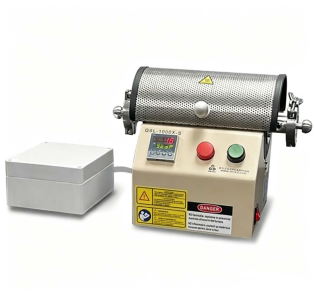
With appropriate electrical modifications, this small tube furnace can be installed inside a glovebox. This allows sample loading, heating, cooling, and retrieval to be performed without leaving the protected environment. Due to its small footprint, it occupies less of the limited internal space compared to conventional furnaces.
Integrating a furnace into a glovebox involves more than simply placing the unit inside; factors such as electrical feedthroughs, transformer placement, heat dissipation, internal gas circulation, external cooling, emergency shutdown protocols, and the glovebox's oxygen removal capacity require careful evaluation. The standard configuration includes a 220V-to-22V transformer, and the final electrical design should be verified with both the furnace supplier and the glovebox manufacturer.
Heat released within the glovebox raises the internal temperature and increases the load on the purification system. Consequently, users must determine the glovebox's maximum operating duration and cooling cycles, as well as maintain safe distances from gloves, windows, filters, sensors, and polymer components. A low-power 500 W design facilitates compact integration, though a formal risk assessment is still required.
2. Catalyst preparation and activation
Catalyst research often involves only minute sample quantities during the initial screening phase. A few hundred milligrams of sample are sufficient to compare variables such as supports, active metal loading, calcination temperatures, or activation gases. Heating a large furnace for such small samples is inefficient and slows down the research cycle.
Small tube furnaces provide a concentrated heating zone suitable for catalyst calcination, drying, activation, reduction, and thermal aging. Horizontal configurations are ideal for processes where gas flows over the sample boat. Vertical operation supports gravity-assisted setups, packed-bed microreactors, or processes involving gas flow through small catalyst beds. This 30-segment programmable controller allows operators to create multi-stage programs. A typical research workflow might include low-temperature drying, slow heating to facilitate precursor decomposition, a programmed activation soak period, and controlled cooling under a protective gas atmosphere. Specific programs must be tailored to the chemical properties of the catalyst and gas safety requirements.
Due to the narrow diameter of the reaction tube, gas residence times and linear velocities can be relatively high, even at moderate flow rates. While advantageous for micro-reaction studies, this necessitates strict control over flow rates. Excessive flow rates can lead to sample cooling, the entrainment of fine powders out of the reaction zone, or pressure buildup at the outlet. Depending on the specific experiment, components such as mass flow controllers, filters, traps, or downstream exhaust systems may be required.
3. Small-scale CVD and VLS Research
Research into nanowires, carbon materials, thin films, and vapor-phase growth mechanisms often begins with small substrates. The furnace provides a compact heating zone around the quartz tube, facilitating exploratory work in Chemical Vapor Deposition (CVD) or Vapor-Liquid-Solid (VLS) growth. Its split-tube design allows for convenient positioning of the heating zone relative to the substrate, source materials, or downstream collection areas.
Horizontal operation is typically used for gas-phase transport along the tube, whereas vertical operation is suitable for processes influenced by gravity, particle sedimentation, or specific precursor placement. In certain configurations, the compact heating zone can be moved relative to the tube, enabling rapid sample exposure or retrieval if the mechanical setup is designed for this purpose.
The high temperature electric furnace itself constitutes only one part of a Chemical Vapor Deposition (CVD) system. Safe operation may require gas cylinders, pressure regulators, mass flow controllers, check valves, purifiers, pressure monitoring devices, precursor bubblers, heated gas lines, cold traps, exhaust treatment systems, leak detectors, and safety interlocks. The use of flammable, explosive, or toxic gases is not recommended with the standard configuration. Any process involving hazardous chemicals must be designed and approved in accordance with institutional and local safety regulations.