


Introduction of the Vacuum Laboratory Hot Plate
2026-01-30 16:54In the daily work of materials laboratories, we often face a tricky dilemma: the need to perform heat treatment or coating on ultra-thin samples (such as crystals, semiconductor wafers, and fuel cell substrates) in a high-temperature environment (300℃-500℃), but traditional mechanical fixing methods can easily cause stress damage.
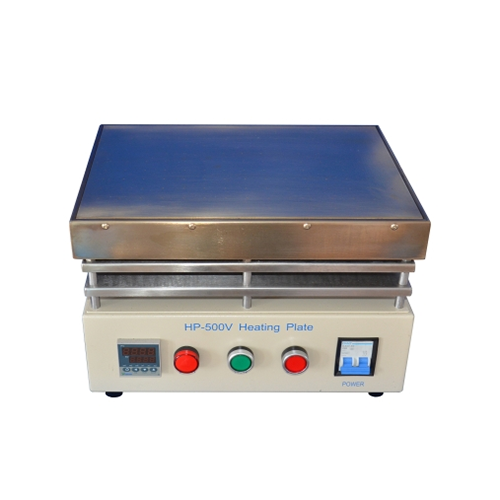
To address this experimental challenge, our team has specifically engineered the HP-500V vacuum laboratory hot plate. Today, we would like to discuss, from a technical perspective, how this device achieves a balance between high-vacuum adsorption and uniform high-temperature heating.
I. Core Material: Why do we insist on using cast brass?
Many laboratory hot plates on the market use aluminum alloy or ceramic, but for the HP-500V, we set the maximum temperature at 500℃. At this temperature range, ordinary aluminum is prone to creep, while ceramics, although high-temperature resistant, are slightly inferior in terms of thermal uniformity.
We chose cast brass as the core heating plate material.
• Deformation resistance: Cast brass maintains excellent mechanical strength at 500℃, and combined with a double-layer heat dissipation structure design, it ensures that the surface does not warp during long-term high-temperature operation.
• Thermal uniformity: The high thermal conductivity of copper allows heat to be quickly transferred from the heating element to the entire surface. For chemical analysis and physical measurement experiments, this means that the temperature difference between the "center point" and the "edge point" is naturally minimized by the physical properties.
II. Vacuum Adsorption:
The biggest feature of the HP-500V laboratory hot plate is the precision adsorption micropores arranged within the 350mm × 240mm effective heating area.
Working principle: The laboratory hot plate requires an external vacuum pump (recommended pumping speed ≥70L/M). Through the negative pressure chamber at the bottom, a strong adsorption force is created on the surface of the heating plate.
Application scenarios: This is especially important for pyrolysis spraying and fuel cell substrate coating. It firmly "adsorbs" the thin film sample to the surface, solving the problem of sample fixation and, because the sample is in close contact with the copper plate, greatly improving heat transfer efficiency and eliminating temperature errors caused by air gaps.
III. Strong Hardware, and the Software to Match. This device is not just a "heating plate," but a precise temperature control system.
PID Artificial Intelligence Temperature Control: We use an AI PID algorithm, ensuring temperature control accuracy stable at ±1℃. During the heating process, the system automatically suppresses overshoot; in the constant temperature stage, it quickly responds to small fluctuations in ambient temperature.
Power Configuration: The 3500W high-power design ensures a fast heating rate, reducing experimental waiting time.
IV. Installation and Usage Suggestions from an Engineer's Perspective.
As technical personnel from the manufacturer, to help you use this equipment effectively, we have a few suggestions based on our debugging experience:
Regarding Ambient Airflow (Very Important):
Although the device has high power, please absolutely avoid placing it near air conditioner vents, in direct airflow from a fan, or in a fume hood with strong airflow. Experimental data shows that strong convective airflow significantly disrupts the temperature field uniformity on the heating plate surface, causing the edge temperature to decrease due to the "wind cooling effect."
Power Supply Environment:
The laboratory hot plate has a nominal current of approximately 16A (based on 220V/3500W), but there will be a surge at startup. The installation requirements clearly state that a single-phase AC 220V 50Hz 25A power supply is required, and it must be properly grounded. Please be sure to check your laboratory's electrical circuit and do not use substandard power strips.
Preheating Practice:
Although it is made of cast copper, before conducting high-precision experiments, it is recommended to maintain the set temperature for 10-15 minutes after reaching it. This allows the heat to fully reach thermal equilibrium throughout the copper plate. Placing the sample at this point will result in the best repeatability of experimental data.
At Shenyang Kejing, before the HP-500V laboratory hot plate leaves the factory, we conduct rigorous insulation tests, grounding tests, and vacuum sealing tests.
This seemingly simple brass heating plate embodies our understanding of material processing technology. Whether you are doing perovskite drying or metal heat treatment, we hope the HP-500V laboratory hot plate will become your most robust, stable, and efficient partner on your laboratory bench.