


How Can PU Polishing Pad Achieve Efficient Rough Polishing?
2026-03-09 13:28Polyurethane (PU) Polishing Pad for Wafer Surface is a specialized consumable designed for high-efficiency rough polishing of hard and brittle materials. It is suitable for the initial polishing stage of samples such as glass, ceramics, gemstones, cemented carbide, and wafers. Its working layer is made of polyurethane material, featuring a unique planar micropore or surface groove structure that effectively stores polishing fluid, ensuring a continuous, stable, and smooth processing.
Material Characteristics of PU Polishing Pad
Polyurethane (PU) Polishing Pad for Wafer Surface has significant advantages in the rough polishing stage of hard and brittle materials. Unlike the soft materials used for fine polishing, the PU polishing pad offers higher hardness, providing stronger material removal force to rapidly eliminate the damaged layer left on the material surface after cutting or grinding. The micropores (in flat-type pads) or grooves (in groove-type pads) designed on its surface primarily function to temporarily store the polishing slurry. Under rotational centrifugal force, these micropores or grooves continuously release the polishing slurry to the contact interface between the sample and the pad, ensuring that abrasive particles persistently participate in material removal and preventing efficiency reduction caused by slurry loss.
Two Types of Surface Design
PU polishing pads come in two surface types to meet different needs:
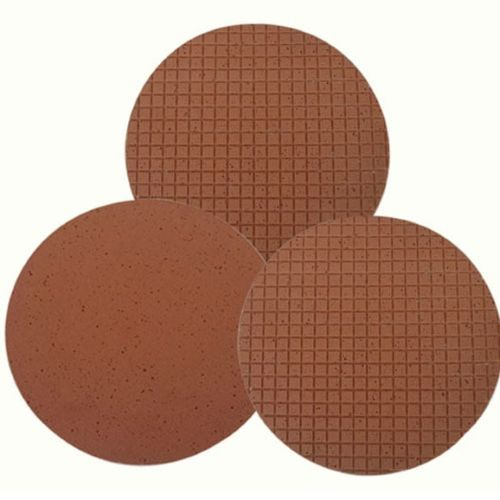
Flat Type (Yellow): The surface is densely covered with tiny pores. The function of these pores is to temporarily store polishing fluid. As the polishing platen rotates, centrifugal force slowly releases the fluid from the pores, continuously supplying it to the processing interface, preventing the pad from drying out during operation.
Grooved Type: The surface features regularly arranged grooves. The advantage of grooves lies in fluid guidance and chip removal. For materials requiring a high flow rate of polishing fluid or those that generate significant debris, the grooves help carry away waste chips, preventing them from scratching the sample surface, while allowing fresh polishing fluid to flow in smoothly.
What are the Specific Advantages of PU Polishing Pad?
Cuts Faster
The hardness of the PU material determines its ability to deliver greater material removal force. When there is a need to quickly modify the sample shape or remove a thick damage layer, its efficiency advantage becomes particularly evident.
Retains Polishing Fluid Longer
Whether micropores or grooves, their core function is to "hold" the polishing fluid. In high-speed rough polishing processes, fluid can easily be flung off. The structural design of the PU pad effectively slows down fluid loss, keeping it in the processing area longer to perform more useful work.
Self-Adhesive Backing
Like most lab consumables, the PU pad features a self-adhesive backing. Clean the platen, peel off the film, and stick it on – done in three steps. The adhesive is water and oil-resistant, sticks firmly, and leaves no residue when replacement is needed.
Which Materials is it Suitable For?
Polyurethane (PU) Polishing Pad for Wafer Surface is primarily used in the rough polishing stage for materials including:
Glass Materials: Optical glass, quartz glass.
Ceramic Materials: Alumina, zirconia, and other structural ceramics.
Gemstone Materials: Sapphire, ruby substrates.
Cemented Carbide: Tungsten carbide, etc.
Wafer Materials: Silicon wafers, silicon carbide substrates.
Why Choose Shenyang Kejing?
Founded in 2000, Shenyang Kejing has over twenty years of production experience in the laboratory equipment field. Products have a standard delivery cycle of 10 working days. Packaging adheres to export-grade wooden case standards, supporting shipping via express, air, and sea freight. Products hold international certifications such as CE and MET, and come with a one-year warranty (excluding consumables like heating elements and seals).
For laboratories dealing with the rough polishing of hard and brittle materials, the Polyurethane (PU) Polishing Pad for Wafer Surface offers a choice that balances efficiency and stability. The microporous structure, combined with the high material removal rate characteristic of the PU material, enables researchers to quickly remove material allowance during the rough polishing stage, laying a solid foundation for subsequent fine polishing processes.