


Key Properties and Manufacturing Quality of Lab Precision Polishing Machine Sandpaper
2026-03-08 08:23In the process of material sample preparation, the quality of the grinding stage directly affects the accuracy of subsequent polishing and microscopic analysis. As the fundamental consumable in the grinding process, the performance parameters of Lab Precision Polishing Machine Sandpaper can influence the overall quality of the preparation workflow.
Abrasive Particle Size Distribution and Grinding Uniformity
The function of Lab Precision Polishing Machine Sandpaper is to mechanically remove material from the sample surface through abrasive particles coated onto a paper backing, progressively eliminating the damage layer introduced during cutting or sectioning. In this process, the concentration of the abrasive particle size distribution directly impacts the uniformity of the resulting scratches.
In actual production, achieving perfectly uniform abrasive particles is challenging. If the particle size distribution is too wide, a few coarse particles can leave scratches on the sample surface that are far deeper than intended. These deep defects are difficult to completely remove during subsequent polishing steps. Conversely, if the proportion of fine particles is too high, the material removal efficiency decreases, prolonging the grinding process and potentially introducing unnecessary mechanical deformation. Therefore, the manufacturing process of the sandpaper must include strict grading and sieving to control the particle size corresponding to a specific grit number within a relatively narrow range.
Backing Adhesion and Operational Stability
During the grinding process, Lab Precision Polishing Machine Sandpaper must withstand the shear forces from rotation and the normal pressure applied by the sample. The secure adhesion of the sandpaper to the polishing platen is a critical factor for stability.
Pressure-sensitive adhesive is the most common type of backing. If the adhesive is unevenly applied or lacks sufficient tack, the edges of the sandpaper are prone to lifting during prolonged operation, or it may even partially detach from the platen. When this occurs, the sample can experience a sudden impact as it passes over a lifted edge, potentially causing irregular surface damage. High-quality Lab Precision Polishing Machine Sandpaper typically utilizes a water-resistant acrylic adhesive system for the backing layer. This is followed by a curing process after application to ensure effective adhesion is maintained even in wet grinding environments. Additionally, the thickness uniformity of the adhesive layer itself is important; excessive thickness variation could lead to minor surface undulations after the sandpaper is applied, affecting the flatness of the sample plane.
Diameter Standardization and Equipment Compatibility
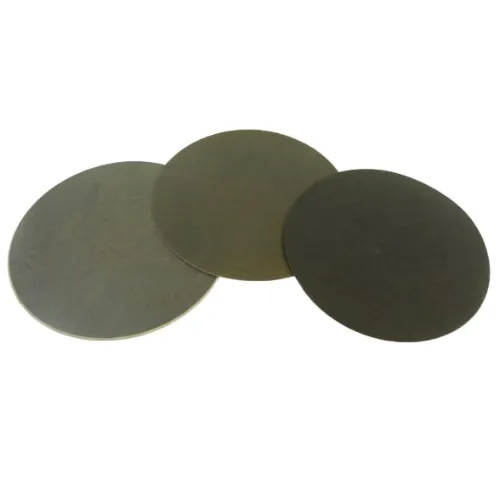
The diameter of polishing platens on precision polishing machines is not universally standardized and can vary between different brands, and even between different models from the same manufacturer. Common diameter specifications for Lab Precision Polishing Machine Sandpaper include 203 mm, 250 mm, and 300 mm.
Matching the specifications is important. If a laboratory procures sandpaper with a diameter slightly smaller than the polishing platen, a gap will remain between the sandpaper's edge and the platen's rim. As the sample rotates over this edge region, part of it may become unsupported, potentially leading to edge chipping or sample tilting. Conversely, if the sandpaper is too large, it requires manual trimming. Achieving a perfectly concentric cut by hand is difficult, and the resulting imbalance during rotation can also negatively impact grinding quality. Therefore, the precision of the cutting process during manufacturing and the completeness of the available size range directly affect how efficiently the consumable adapts to the equipment.
Abrasive Grain Bond Strength and Service Life
The abrasive grains are attached to the paper backing by a resin bond. The level of bond strength needs to strike a balance between maintaining cutting ability and extending the sandpaper's life.
If the bond strength is too high, dulled grains do not fracture or pull out easily. The surface of the Lab Precision Polishing Machine Sandpaper gradually becomes covered with flattened grains, forming a "glazed" layer, which significantly reduces cutting efficiency. If the bond strength is too low, grains are shed prematurely before they have fully contributed to the cutting action. This not only shortens the effective life of the sandpaper but also means the loose, shed grains can roll between the sample and the paper, causing random scratches. During production, the formulation of the bond and the control of the curing temperature determine the timing of grain detachment. In the laboratory, users can indirectly assess whether the grain retention is appropriate by observing changes in cutting force and the morphology of scratches during the grinding process.
Shenyang Kejing's Technical Practice
With 26 years of experience in the research and development of material analysis equipment, Shenyang Kejing's Lab Precision Polishing Machine Sandpaper utilizes strictly graded abrasive particles. Through precise particle size distribution control, it achieves a uniform surface and a shallower deformation layer on the sample. The company was founded in May 2000 and possesses a 12,400 square meter modern R&D and manufacturing base, employing over 90 people, including more than 20 in its technical R&D team. Since 2007, its products have been progressively adopted by university laboratories, including Tsinghua University and Peking University, as well as key national research institutions. In 2013, the company's three main product series—Cutting, Grinding & Polishing, and Coating—obtained CE certification. Currently, Shenyang Kejing has been recognized as a High-Tech Enterprise, a Liaoning Provincial Specialized and Sophisticated SME, and a Liaoning Provincial Enterprise Technology Center. In 2024, the company showcased its technological capabilities in the field of material analysis equipment by exhibiting products such as fully automatic precision sectioning saws and floor-standing grinding & polishing machines at the 25th China International Optoelectronic Exposition (CIOE).