


Ultrasonic Spraying vs. Pressure Spraying: Why Does Ultrasonic Atomization Technology Excel in Perovskite and Fuel Cell Research?
2026-04-22 09:33The industry is gradually shifting toward "spray coating" processes; however, not all spraying methods offer equal efficacy. Researchers are increasingly seeking a solution that can achieve "nanoscale uniformity" while avoiding the issues of particle agglomeration and material waste often associated with traditional pneumatic nozzles.
1. Scientific Principles: Why is a 40 kHz Frequency So Important?
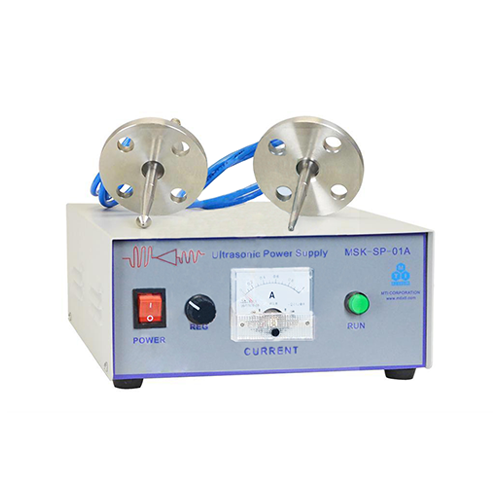
The operating principle of the MSK-SP-01A Lab Ultrasonic Atomization Module differs fundamentally from that of a standard paint spray gun. Instead of utilizing a high-pressure airflow to "shear" liquid into droplets, it employs high-frequency ultrasonic vibrations (40 kHz) to achieve atomization.
Working Mechanism: A piezoelectric ceramic element converts electrical energy into mechanical longitudinal waves. As the precursor solution flows to the tip of the titanium alloy nozzle, these vibrations generate "capillary waves" on the liquid surface. Once the amplitude reaches a specific threshold, the liquid ruptures and atomizes into a fine, uniform mist with an average droplet size of approximately 25 µm.
2. Solving Three Core Research Pain Points.
I. Material Conservation.
Traditional pressure spraying generates a high-velocity "bounce-back" effect—where droplets scatter upon impact with the substrate. In contrast, ultrasonic spraying produces a low-velocity droplet stream that adheres firmly to the substrate surface, thereby minimizing "overspray." This allows researchers to save up to 90% on materials—an undeniable cost advantage, particularly in research involving rare catalysts or expensive perovskite salts.
II. Say Goodbye to Nozzle Clogging.
Few things can ruin a week's worth of research faster than a clogged nozzle. Because the MSK-SP-01A nozzle vibrates continuously at a frequency of 40,000 times per second, it possesses an inherent "self-cleaning" capability. This design effectively prevents the accumulation of solid matter—the most common cause of failure in traditional pressure nozzles when processing high-concentration suspensions.
III. Uniformity.
The MSK-SP-01A lab ultrasonic atomization module generates droplets of nearly identical size. This results in "pinhole-free" coating effects—a critical factor for fabricating high-performance Electron Transport Layers (ETLs) and Hole Transport Layers (HTLs) in solar cells.
3. Typical Application Cases:
Perovskite Solar Cells: Preparation of large-area, high-efficiency light-absorbing layers.
Fuel Cells (PEMFC): Precise deposition of platinum (Pt) catalyst layers onto carbon paper substrates.
Biomedicine: Coating of sustained-release drug polymers onto stent surfaces.
Electronics Industry: Spray coating of Transparent Conductive Oxides (TCO) for flexible display manufacturing.
4. Why Choose the MSK-SP-01A?
The MSK-SP-01A is specifically designed for laboratory integration applications and features the following outstanding characteristics:
Titanium Alloy Construction: Offers exceptional corrosion resistance against acidic or alkaline precursor solutions.
130W Power Control: Enables precise flow rate control (covering a range from 0.1 ml/min to 40 ml/min).
Compact Design: Easily integrates into existing gloveboxes or CNC spray coating systems.