


Eliminating Deformation Layers: Why Your Lab Needs an Electrolytic Polisher & Etcher
2026-04-11 16:51In the fields of materials science and metallography, the accuracy of microstructures observed under a microscope depends entirely on the quality of the preceding sample preparation. While traditional sandpaper grinding and mechanical polishing are widely practiced, they often introduce a critical drawback: a mechanically deformed layer.
For researchers requiring high-magnification electron microscopy (SEM/TEM) observations, or those working with extremely soft or hard materials, laboratory electrolytic polishing and etching systems have become essential equipment.
Mechanical polishing relies on the physical abrasive action of grinding media; this inevitably leaves microscopic scratches on the metal surface and generates residual stress, leading to lattice deformation at the surface.
In contrast, electrolytic polishing is an electrochemical process. It treats the sample as an anode and, under specific electrolyte and voltage conditions, achieves surface leveling by selectively dissolving microscopic protrusions on the metal surface. Its greatest advantage is that it is completely stress-free. It reveals the material's true microstructure with 100% fidelity—devoid of any artifacts—making it the perfect prerequisite for high-precision failure analysis and grain boundary observation.
Aluminum alloys, stainless steels, and titanium alloys are notoriously difficult to polish; is electrolytic polishing effective for them?
Absolutely. In fact, for extremely soft metals (such as pure aluminum or pure copper) or metals highly susceptible to mechanical scratching (such as titanium alloys), mechanical polishing is often inefficient and yields poor results. Electrolytic polishing is the optimal choice—and the industry standard—for processing these alloys, as it delivers a flawless surface in a very short time: scratch-free, highly polished, and a true reflection of the underlying matrix.
Can a single device handle both "polishing" and "etching"?
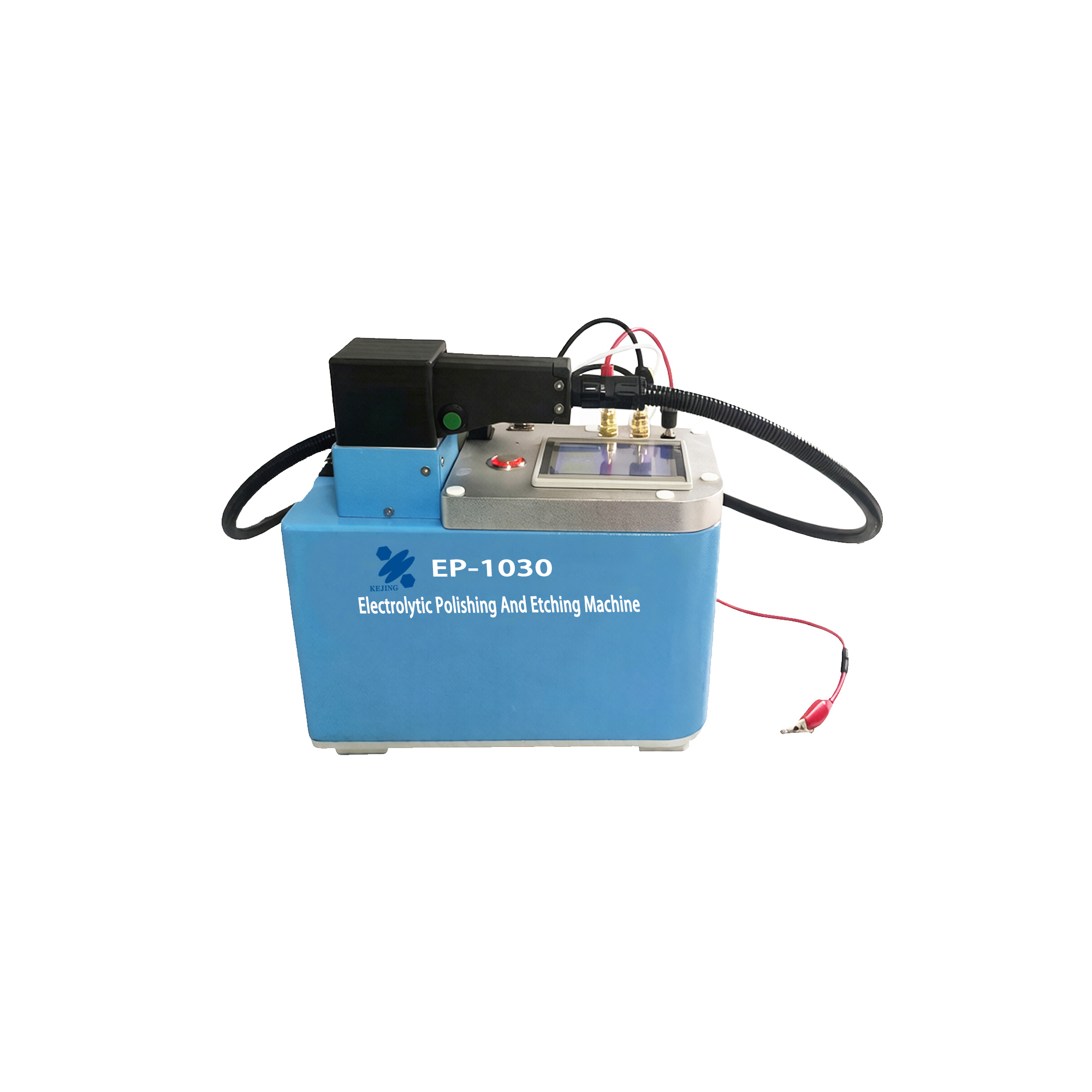
In the past, this typically required two separate setups. However, modern advanced equipment—such as the EP-1030 metallographic electrolytic polisher—seamlessly integrates both functions into a single, compact unit.
The distinction between polishing and etching primarily lies in the differences in current density and voltage. The EP-1030 metallographic electrolytic polisher features an intuitive touchscreen interface and a PLC controller, allowing users to continuously adjust the output voltage (1–30 V) and current limit (10 A) in real time. With just a simple tap on the screen to toggle the settings, you can utilize the same electrolyte solution to seamlessly transition from polishing to etching.
Why is precise control of the electrolyte flow rate essential?
During the electrolytic process, if localized reaction products are not removed promptly, the sample surface becomes highly susceptible to developing unsightly "pitting." The EP-1030 features a built-in precision peristaltic pump with an adjustable speed range of 2 to 50 rpm. By optimizing the flow rate—tailored to the specific material and the viscosity of the electrolyte—the system ensures a smooth, consistent flow across the surface. This action not only sweeps away bubbles and dissolved byproducts but also effectively regulates the surface temperature, thereby guaranteeing exceptional reproducibility in the polishing results.
Advancing Towards Efficient and Portable On-Site Metallographic Inspection:
Beyond its outstanding performance within the laboratory, the compact design of the EP-1030 metallographic electrolytic polisher makes it ideally suited for field use in industrial plants. It enables non-destructive testing and metallographic replica preparation on pipelines or large-scale structural components directly on-site. Bid farewell to time-consuming and labor-intensive manual grinding, and experience a qualitative leap forward in sample preparation efficiency.
Contact our technical team for EP-1030 pricing & advice.