

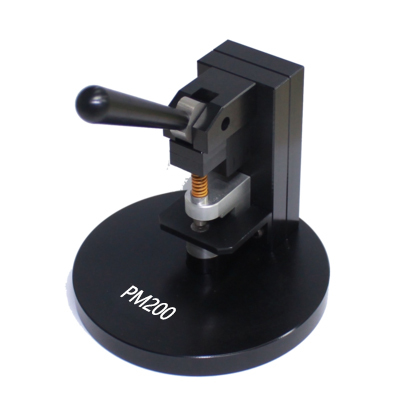
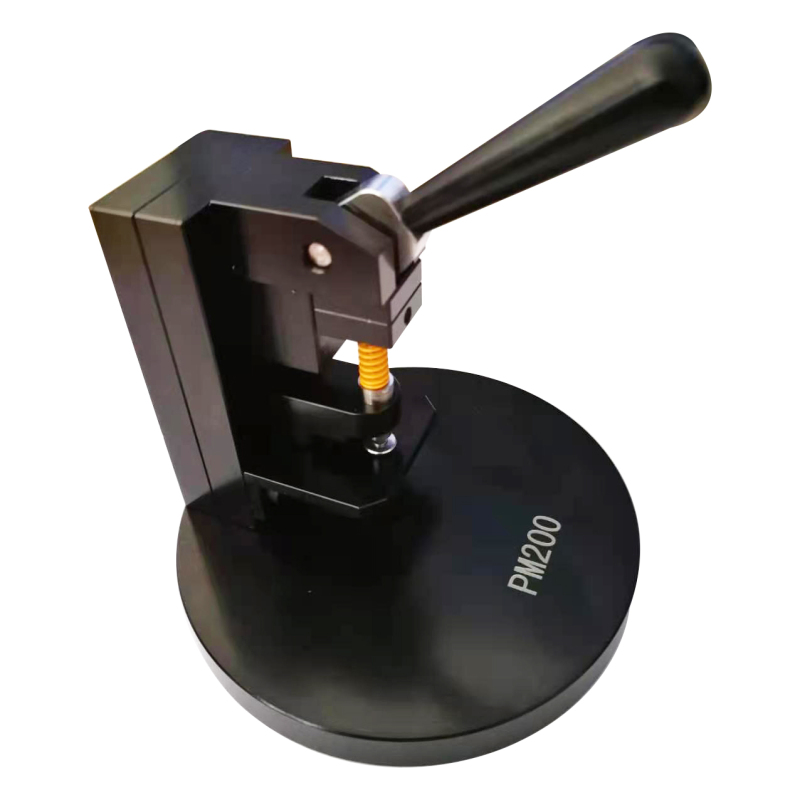
Wafer Puncher for Metals
1. The metal wafer puncher is mainly used for most types of metal materials (possessing good toughness or ductility).
2. The equipment can perform standard punching, with consistent dimensions and error-free experimental data.
3. The equipment is designed and manufactured in-house, ensuring high quality. We provide warranty service for any problems with the equipment itself.
- Shenyang Kejing
- Shenyang, China
- 10 working days
- 50 sets
- Information
Technical Parameters of lab wafer puncher:
Product name | PM200 metal wafer puncher |
Product model | PM200 |
Major parameters (specification) of lab wafer puncher | 1. sample size: φ3mm 2. disc thickness: 50-120um 3. punching times: 20000 times 4. product weight: 0.5Kg |
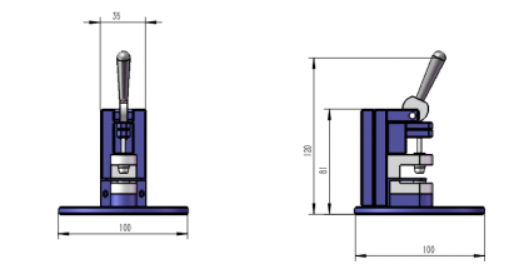
Product dimension | Dimension: 100mm*100mm*120mm
|
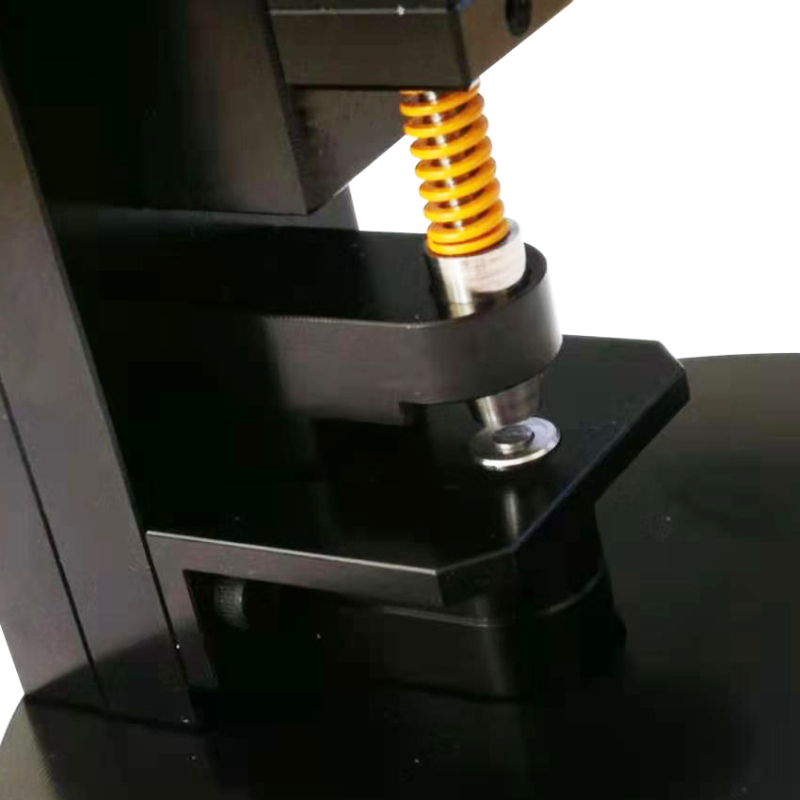
cautions | 1. The metal disc is placed on the plane of the lower die base of the puncher. 2. Press the pressure rod downward until the punch head and the lower die base are pressed tightly. 3. when releasing the pressure rod, the spring reaction force will reset the pressure rod. If used vertically, the samples need to be taken out or shaken off manually; if used horizontally, the samples will fall down automatically. 4. When the service life comes closely to its end, the punch head may cause irregular edge due to slight wear, and the puncher needs to be replaced at this time. |
Introduction of lab wafer puncher:
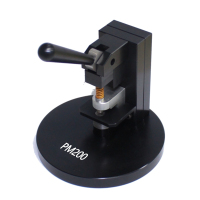
PM200 metal wafer puncher can be used together with a distortion-free transmission electron microscope (TEM) when preparing samples. The product punches the metal disc to obtain the required sample, which reduces the difficulty of manual manufacturing as well as the preparation time. The product is used to prepare wafers of 3mm diameter, and is mainly used for metal materials with extensibility and good toughness. Compared with similar products on the market, PM200 metal wafer puncher has better repeatability and higher dimensional accuracy when preparing wafer samples of the same size, and the service life is several times that of similar products. PM200 punching machine for tem samples is made of light aluminum alloy as the base, and the surface is treated with special sandblasting oxidation, which makes it very smooth when touched. The punch head is made of die steel and its surface hardness and wear resistance are improved after heat treatment, therefore the service life is greatly increased. The product uses a lever structure to reduce the force of the operator and is ergonomic friendly. If wafers of special sizes are required, the puncher can be customized individually.
Main Features of lab wafer puncher:
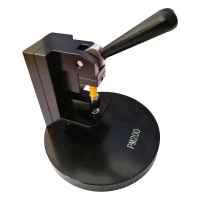
1. It can used either "vertically" or "horizontally", and enables single punching and multiple continuous punching onto the samples.
2. The punch head is made of high-quality die steel, and after CNC precision machining, it has the features of high coaxiality, smooth surface, and controllable clearance.
3. The puncher base is made of aluminum alloy, and the surface is anodized, which is light in weight and fadeless in color.
4. The lever-type punching method with moderate force and appropriate resilience makes it easy to press and fit.
5. With automatic unloading mechanism, the sample is automatically ejected after punching.
6. When running horizontally, the material is automatically received, and continuous punching can be performed.
Logistics of disc punch machine for tem samples:

Applications:
The PM200 Metal Wafer Puncher is widely used in the following research and industrial fields:
Transmission Electron Microscopy (TEM) Sample Preparation: Specifically designed for punching standard φ3mm metal wafers, preparing for further thinning in TEM (Transmission Electron Microscopy) (such as dual-jet electrolytic thinning, ion thinning), making it an indispensable sample preparation tool in electron microscopy laboratories.
Materials Science and Engineering Research: Suitable for precise sampling of various metal and alloy foils (50-120μm thick) with good ductility and toughness, aiding in the analysis of material microstructure and crystal defects.
Metallurgical Industry and Failure Analysis: Used to extract minute feature samples from metal strips or near fracture surfaces for in-depth phase transformation analysis or fatigue testing studies.
Semiconductor and Microelectronics Testing: Can be used to punch flexible metal substrates, conductive foils, or contact electrode materials to specific dimensions for microscopic morphology observation and electrical performance testing.
University and Research Institute Laboratories: With its durable die steel punch and ergonomic lever design, it is ideal for public testing platforms and research centers requiring high-frequency, high-volume preparation of standardized samples.
Frequently Asked Questions:
Q1: What types of materials can the PM200 punching machine handle?
A: This punching machine is mainly designed for metal and alloy foils with a certain degree of ductility and good toughness. It is not recommended for extremely brittle materials (such as ceramics or glass) to avoid damaging the punch.
Q2: What is the suitable sample thickness for punching?
A: The recommended metal foil thickness range is 50μm to 120μm. Within this range, optimal edge quality and die life can be guaranteed.
Q3: What is the size of the punched discs? Can it be customized?
A: The standard punching size is φ3mm, which is common for transmission electron microscopy (TEM). If you require discs of special sizes, we support customized services; please contact our sales team for details.
Q4: What is the continuous punching life of this machine?
A: The PM200 uses high-quality die steel punches that have undergone heat treatment, designed for approximately 20,000 punching cycles, several times the lifespan of similar products on the market.
Q5: How do I determine when to replace the punch or the machine?
A: When the machine is nearing its lifespan limit, or when irregular burrs or deformation appear on the edges of the 3mm small discs, it indicates that the punch has experienced slight wear. In this case, to ensure the quality of TEM samples, it is recommended to replace the punching machine.
Q6: How does the machine achieve automatic unloading?
A: The punching machine has a built-in automatic unloading mechanism. When the "horizontal" placement method is used, the punched material will automatically fall and be received, which is very suitable for continuous, large-volume punching operations.