

Spherical Pulsed Laser Deposition System
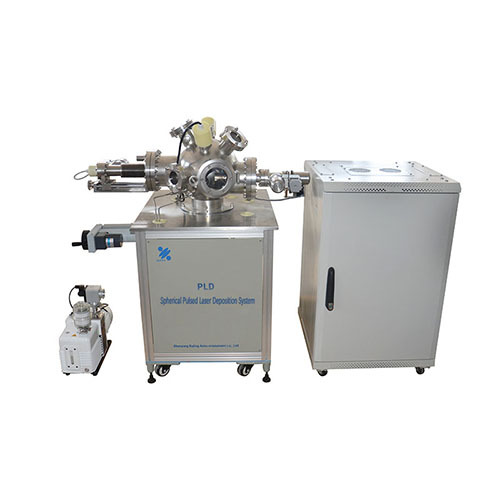
This system is a research and development equipment for spherical pulsed laser deposition system (PLD). Pulsed laser deposition technology is widely used, and can be used to prepare thin films of various substances such as metals, semiconductors, oxides, nitrides, carbides, borides, silicides, sulfides and fluorides. It is even used to prepare some difficult-to-synthesize material films, such as diamond and cubic nitride films.
- Shenyang Kejing
- Shenyang, China
- 44 working days
- 50 sets
- Information
Product Introduction
The Spherical Pulsed Laser Deposition (PLD) System is a high-performance research and development platform designed for advanced thin film fabrication. Pulsed Laser Deposition (PLD) is a technique in which a high-energy laser beam is focused onto a small area of the target material. The intense energy density vaporizes or ionizes part of the target, causing the ejected material to travel toward the substrate, where it condenses to form a thin film.
Among various thin film preparation methods, PLD has been widely applied to deposit a broad range of materials, including metals, semiconductors, oxides, nitrides, carbides, borides, silicides, sulfides, and fluorides. It is also capable of fabricating films of materials that are otherwise difficult to synthesize, such as diamond and cubic boron nitride (c-BN).
The spherical PLD system features a spherical vacuum chamber design and utilizes high-energy laser pulses (power < 4 kW) for precise target evaporation, enabling uniform thin film deposition of metals, oxides, and nitrides. Its high vacuum capability ensures exceptional film purity. The four-position rotating target assembly allows for multi-material sequential deposition without breaking vacuum.
Constructed with a stainless-steel chamber equipped with an observation window and MFC-controlled gas inlet, the system supports experiments involving refractory materials such as diamond and cubic nitrides. This equipment is ideally suited for universities and research institutes engaged in high-end thin film studies, particularly those requiring stringent control over film composition and microstructure.
Main Features
1. Spherical Vacuum Chamber Design: Made of 304 stainless steel with argon arc welding, providing an effective chamber diameter of Φ300 mm. Equipped with a visible observation window for real-time experiment monitoring.
2. Ultra-High Vacuum Performance: Achieves extremely high ultimate vacuum, fast pumping speed, and low leakage rate.
3. Precise Laser Deposition: Utilizes high-energy laser pulses (<4 kW) to evaporate target materials, supporting thin-film deposition of metals, oxides, nitrides, and other compound materials.
4. Four-Target Rotating System: Features planetary and self-rotation with single-target exposure via a shutter, enabling multi-material continuous deposition.
5. High-Temperature Substrate Holder: Provides precise temperature control and adjustable rotation speed to meet complex process requirements.
6. Research-Grade Compatibility: Capable of preparing refractory materials such as diamond and cubic nitride films, ideal for advanced material R&D.
7. Intelligent Safety Configuration: Equipped with built-in baking, illumination, and water-pressure alarm systems; MFC-controlled gas inlet (0–100 sccm) ensures stable process conditions.
8. Fast Recovery Capability: Maintains vacuum ≤20 Pa after a 12-hour pump shutdown, improving experimental efficiency.
9. Modular Structure: Adjustable distance between substrate holder and rotating target system for flexible adaptation to different deposition setups.
10. Optimized for Small-Scale Production: Suitable for universities and research institutes, combining exploratory research with precision thin-film fabrication.
Technical Parameters
Product name | Spherical Pulsed Laser Deposition System (PLD) |
Installation Conditions | 1. Ambient temperature: 10℃~35℃ 2. Relative humidity: no more than 75% 3. Power supply: 220V, single-phase, 50±0.5 Hz 4. Equipment power: less than 4kW 5. Water supply: water pressure of 0.2MPa~0.4MPa, water temperature of 15℃~25℃, 6. The surrounding environment of the equipment should be tidy, the air should be clean, and there should be no dust or gas that can cause corrosion on electric appliance or other metal surface or cause conduction between metals. |
Major Parameters (Specification) | 1. The system adopts a spherical structure and manual front door. 2. The vacuum chamber components and accessories are all made of high-quality stainless steel (304), argon arc welding, and the surface is treated with glass blasting and electrochemical polishing and passivating. 3. The vacuum chamber is equipped with a visual observation window. The effective size of the vacuum chamber is Φ300mm. 4. Limit of vacuum degree: ≤6.67×10⁻⁵Pa (After baking and degassing, use 600L/S molecular pump to pump air, and use 8L/S for the front stage); · Leak rate of system vacuum leak detection: ≤5.0×10⁻⁷Pa.L/S; · The system starts to pump air from the atmosphere to 8.0×10⁻⁴ Pa, which can be reached in 40 minutes; · The vacuum degree after the pump is stopped for 12 hours: ≤20 Pa 5. Sample stage: the sample size is φ40mm, the rotation speed is 1-20RPM, and the distance between the substrate stage and the rotation target is 40-90mm. 6. The maximum heating temperature of sample: 800℃, temperature control accuracy: ±1℃, and the temperature control meter is used for temperature control. 7. Four-station rotation target: each target position is φ40mm, only one target position is exposed on the baffle/shutter, the laser beam is required to hit the top target position, and the rotation target has the functions of revolution and autorotation. 8. Baking, illuminating and water pressure alarm devices are installed in the vacuum chamber 9. MFC one-way mass flow meter ( to control the intake air): 0-100sccm |
Warranty
One year limited with lifetime support (not including rusted parts due to inadequate storage conditions)
Logistics